People’s Daily Health Client: Efficient and Cost-Effective — More and More Foreign Patients Are Coming to China for Medical Treatment
“I was able to have my surgery and be discharged within just one week in China. That’s faster than getting treatment for a common cold abroad!”
Before coming to the First Affiliated Hospital of Zhejiang University School of Medicine, Saleh (pseudonym), a patient from Bangladesh, had sought medical care in several countries but was still unable to find the cause of his condition. Yet here, he saw a doctor on Day 1, was admitted on Day 3, underwent surgery on Day 4, and was discharged on Day 7. The hospital’s medical team resolved a medical problem that had troubled Saleh for six years—in just one week.
In recent years, China’s efficient and highly skilled medical services have increasingly attracted international attention, with many overseas patients traveling thousands of miles to seek treatment in China. According to data, in 2023, 13 designated hospitals in Shanghai treated nearly 270,000 foreign patients, an increase of 15% year on year. That same year, Shenzhen provided medical services to 770,000 patient visits by foreign nationals, up 20% year on year.
“Foreign patients coming to China for medical treatment is becoming a growing trend,” Jin Chunlin, director of the Shanghai Health Development Research Center, told the People’s Daily Health Client on June 9. From a broader trend perspective, cross-border medical care in China is showing three major developments. First, the number of foreign patients is steadily increasing. Second, the structure of medical needs is changing significantly—from emergency treatment for sudden illnesses occurring during business trips or tourism to proactive medical needs, including elective surgery. Third, the geographic origins of patients are expanding from neighboring countries to a wider range of regions, including Europe and the United States.
From Emergency Care to Elective Surgery, More Foreign Patients Are Coming to China for Treatment
“This hospital is extremely efficient. The equipment is all new, the doctors are highly trained, and the treatment was provided very promptly. I spent only a few hundred dollars on treatment here. In the United States, it could have cost around $8,000.”
In January this year, 73-year-old American architect Robert shared a video on social media about his treatment experience at the First Affiliated Hospital of Zhejiang University School of Medicine, attracting widespread attention.
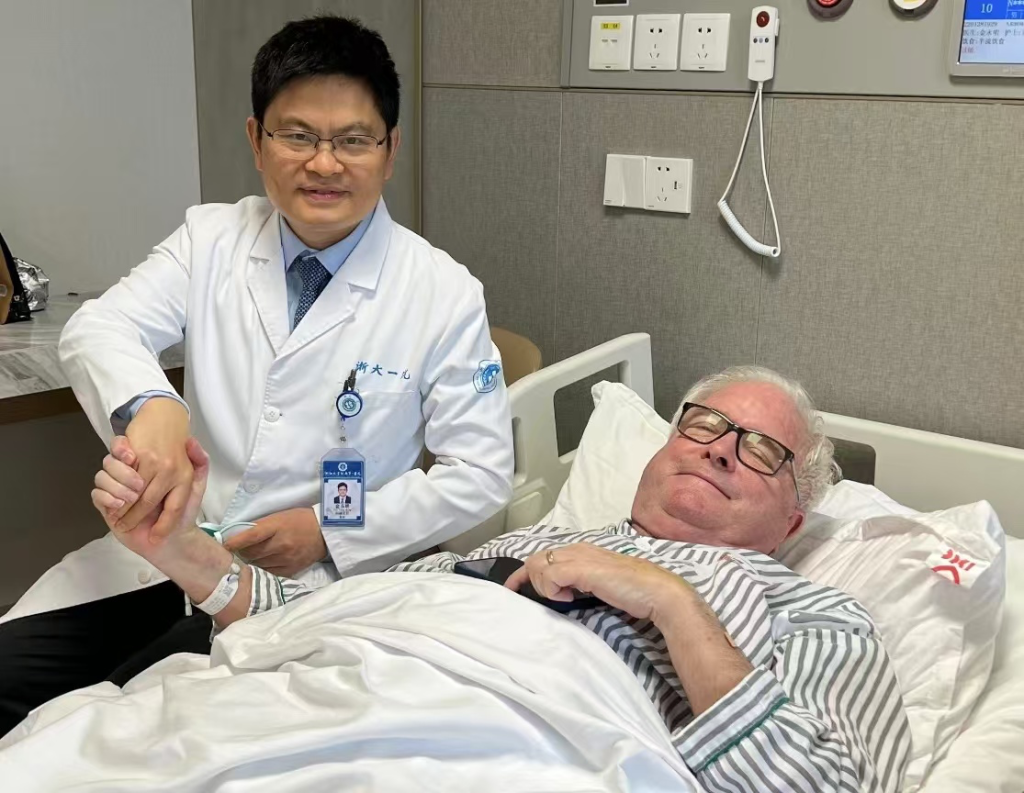
Over the past two years, Robert, a patient from the United States, has undergone three surgeries at the First Affiliated Hospital of Zhejiang University School of Medicine: one minimally invasive lumbar spine procedure and two cataract surgeries, one on each eye.
Photo courtesy of the First Affiliated Hospital of Zhejiang University School of Medicine.
On June 9, Yuan Qiaomei, director of the International Healthcare Center at the First Affiliated Hospital of Zhejiang University School of Medicine, told the People’s Daily Health Client that the center was established in September 2022. Over the past three years, the number of foreign patients seeking treatment there has continued to rise. In 2024 alone, the hospital treated foreign patients from more than 60 countries and regions, representing a 45.6% increase. In terms of geographic distribution, Asia and ASEAN countries were among the primary sources, followed by Europe, Oceania, and Africa. Meanwhile, the proportion of elective surgeries has continued to increase.
“For foreign patients, the appeal of Chinese hospitals lies first and foremost in the high quality of medical care and the smoothness of the treatment process,” Yuan Qiaomei said, explaining why medical care in China has become increasingly popular among foreign patients.
She cited the Bangladeshi patient mentioned above as an example. Before coming to China, he had sought treatment at hospitals in Bangladesh, India, and Singapore, where he was consistently diagnosed with arterial atherosclerotic occlusive disease. His condition was relatively serious, and the waiting time for surgery was long. Ultimately, Li Donglin, chief physician of vascular surgery, identified the root cause through detailed examinations: arterial embolism in the limb caused by a detached blood clot. This was an entirely different diagnosis, and because the condition is relatively uncommon in clinical practice, surgery was promptly arranged.
Jin Chunlin also noted that the key factors attracting foreign patients to China are primarily advanced technologies and specialized medical services, followed by advantages in efficiency and cost. In terms of access to care, China is significantly more efficient than some developed countries; at some hospitals, patients can even complete complex examinations such as MRI and CT scans on the same day. In terms of cost, a number of Chinese hospitals have already incorporated multiple commercial health insurance plans into their reimbursement systems. Even for patients paying entirely out of pocket, the costs of surgery and other treatments in China are considerably lower than those in many overseas countries.
Management Lacks Unified Standards, and a Multilevel Service System Needs to Be Developed More Rapidly
Since May, cities including Changsha and Hainan have introduced a series of innovative measures to make it easier for foreign nationals to access local healthcare. Several other regions had previously introduced related policies.
Beijing launched its international medical care pilot program in 2019, initially involving six medical institutions. The program has since expanded to 19 institutions. Shanghai, a major destination for foreign nationals and international visitors, designated 13 tertiary Grade A general hospitals and specialized tertiary hospitals as international medical tourism pilot institutions in 2023. Shenzhen has also selected 10 hospitals for its pilot program, with the aim of attracting international patients.
Although various regions have begun placing greater emphasis on international healthcare, relevant standards and regulations remain underdeveloped. In October 2024, Shanghai issued the local standard Specifications for International Medical Services, marking China’s first exploration of standardized regulations specifically for international medical services and signaling a new stage of standardized development for international healthcare in Shanghai. In other regions, however, the management of international medical services is still largely determined independently by individual hospitals.
“Although China’s medical capabilities and cost-effectiveness have gained a certain level of recognition among international patients, the sector still faces several challenges,” Jin Chunlin said.
First, service quality still needs to be improved, including issues related to entry visas and language barriers. Second, the payment system has not yet been sufficiently integrated with international standards, and many hospitals are still unable to work directly with international commercial health insurers. Third, cultural adaptability remains inadequate, with issues such as privacy protection and cultural differences requiring greater attention. Fourth, policies remain fragmented. China currently lacks unified national standards for the management of international medical services, and the introduction and implementation of relevant regulations should be accelerated.
Source: First Affiliated Hospital of Zhejiang University School of Medicine
https://www.zy91.com/content/default/64/9445
